Wednesday, August 21, 2019

Mandan Territory

Inclement weather
We left out early from St. Cloud expecting a long day. We did not expect intense rain, and rain that lasted much of the morning. But it faired off after lunch and the rest of the day was gorgeous. The hills are a little more rolling but the agriculture is still predominantly soybeans and corn with the occasional field of sugar beets and sunflowers. As we headed into North Dakota, wheat and hay were added to the mix. As before, the fields are vast. In North Carolina, the roadside patches of wildflowers have been planted to reduce mowing costs. In North Dakota, sections of
Roadside harvest
roadside are leased to farmers who harvest hay off of them--a boon to the farmers and the DOT.

We arrived in Bismark, ND mid afternoon really looking forward to NOT hustling up the road again for a few days. We are close now to the places we'd planned to visit and it finally feels like we are on vacation. As if to mark the occasion, Ruthie
Our current home, #52


pointed out the street sign in the RV park where we were to camp.

It was lovely to be leisurely. We ate a good supper, walked the park several times to get the cramps from sitting out of our legs, and we ended the day watching the pool robot wander aimlessly around the pool doing I'm not sure what. Ben talks about his daily pool maintenance routine at Millstone. I need to ask him about this.

Pool bot


Our goal today was to explore Lewis and Clark's interactions with the Mandan Indians. As I have mentioned, Ruthie is the navigator here. I enjoyed an abridged audio version of Undaunted Courage about their expedition but was so dismayed with their intent to exploit the natural resources and their shabby treatment of the Indians I didn't retain much. It was an incredibly difficult trip and involved courage, ingenuity and determination but it was, in the end, greed-based and I have a hard time calling them heros. So I'm basically here to enjoy the scenery and I'm
Ft Lincoln memorial to the CCC
Entrance to an Earthlodge
leaving the history stuff to Ruthie. I was a little confused when she used the word Mandan in several different ways. So this is what I've learned: Mandan is a small town just outside Bismark; about 20 miles south of Bismark is a Mandan Village called On A Slant; thirty five miles north of Bismark is Fort Mandan (in Washburn, ND) where the explorers spent their first winter in a palisade fort, trading with other Mandan Indians and stocking up on food.
Mandan Earthlodges
Today we were in all of them. And in Washburn, we also visited the Lewis and Clark Interpretive Center and saw a wonderful exhibit of paintings depicting Sakakawea (Sacagewea or one of many other spellings), but I'm getting ahead of myself.

We started out south of the town of Mandan visiting Fort Lincoln State Park. We were greeted at the entrance by a wonderful statue honoring the three million men who participated in the Civilian Conservation Corps. During
Inside an earthlodge
the Depression, these men built many state and national parks and, because of their training and experience, were the first to enlist during World War II. Fort Lincoln is also home to a reconstructed Mandan village. On A Slant was so named because the village was on land that slanted towards the Missouri River. It was protected by a natural ravine, hand dug moat and palisade fence, and the river itself. At its peak it held 85 earthlodges. The earthlodges, built largely by women, were built on a frame of heavy timers overlayed with willow and thatch, then covered in dirt. The Mandan liked the white folks, were prolific farmers and enjoyed trading their surplus produce with the white trappers. Their territory was a good place for L&C to spend a winter acclimating to native interaction.

This village was on the decline due
On A Slant overlooking the river
to smallpox when L&C were in the area so Fort Mandan is about 45 miles north, but you can see from the picture, its position overlooking the river was both lovely and secure.

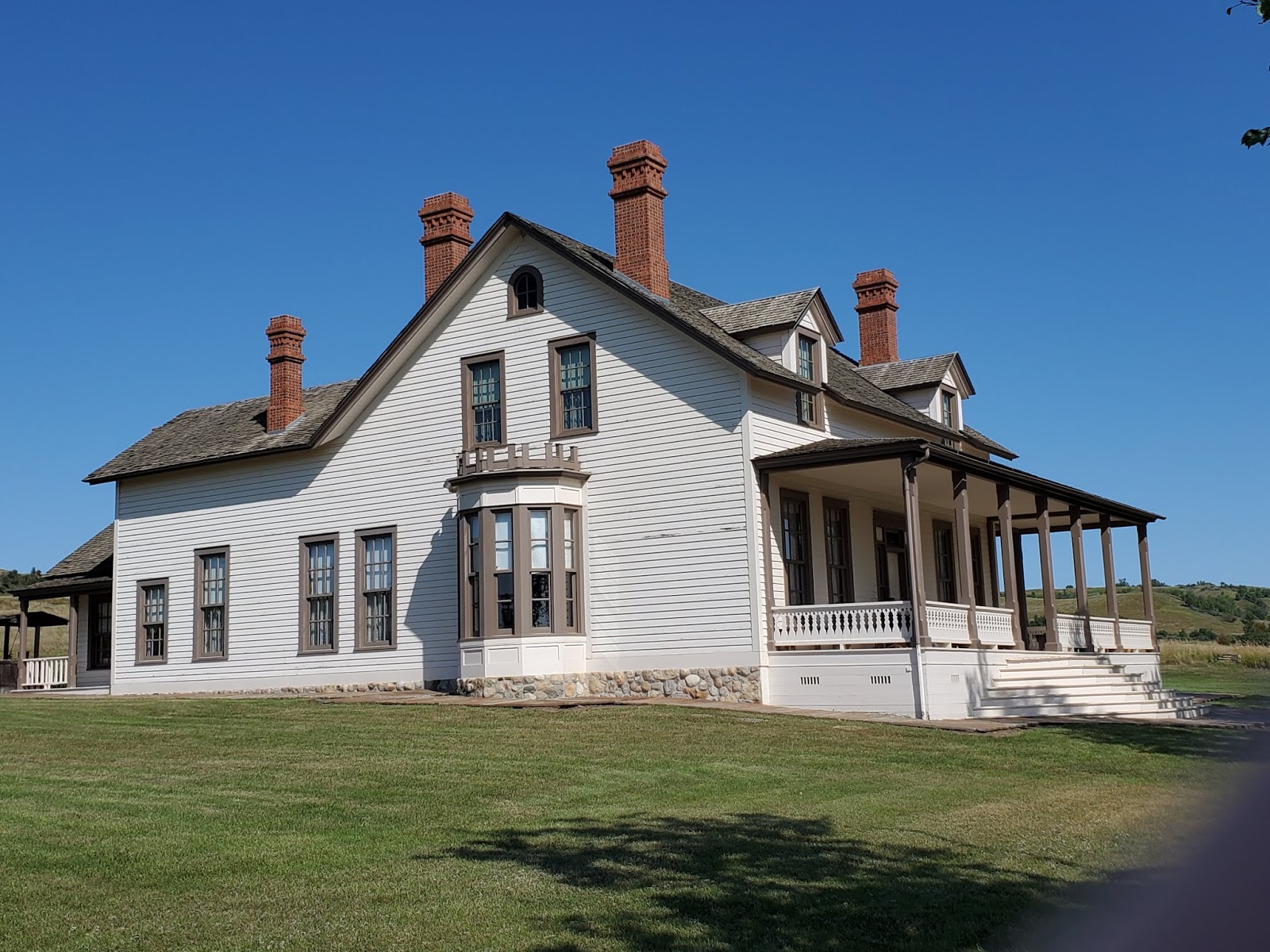
Seventy years later, Fort Lincoln was the last home of General George Custer. He left Fort Lincoln to arrive at Little Big Horn about 6 weeks
Custer's last home.
later. His home (officer's housing) on the fort has been beautifully restored. The Interpreter, a local college student studying to be a social studies teacher, was full of information and recommendations for things to see up the road. Their gift shop and book store were pretty awesome as well.

Fort Lincoln Interpreter


Our next stop was Washburn, ND for the Lewis & Clark Interpretive Center and Fort Mandan itself. We took a scenic backroad that frequently overlooked the Missouri River. We saw our first buttes. And we had a great lunch at a Dakota Farms restaurant that serves local meats and produce.

The land is open, we are in the prairie now. Lots of pasture and hay production, lots of wheat. It appears corn needs to be irrigated here, though we saw plenty along with soybeans. We saw lots of sunflowers here, cultivated in huge fields.
Buttes beyond the river

Along the river, the hills are gentle but irregular and include the flat-topped or pointed "buttes" characteristic of the area--hills that rise abruptly, with steep slides. Trees are in the minority and cluster in protected areas among the hills or have been planted in deliberate windrows to protect buildings and crops. In the natural areas, it is grassland, and lots of it.

Once in Washburn, we started at the Lewis and Clark Interpretive Center with its
L&C Interpretive Center
collection of artifacts and renderings of Sakakawea. Our day passes allowed us entry into the Fort Mandan historical site another 2 miles up the road. The fort was originally placed 10 miles up the river, but with flood control dams and time, the original site is underwater. Local historical groups lovingly recreated the original building on this site and filled it with period artifacts and reproduction costumes. There was a mile long walk along the river with informational signs about living conditions and natural history.
Dugout, tent and faithful dog


We saw a dugout canoe like the ones L&C took up river to the river's mouth and we saw a wonderful statue of William Clark's Newfoundland dog, Seaman, who faithfully journeyed the 8000 miles they traveled and guarded Clark's  tomb after he died. Most impressive was to
Fort Mandan
see a period sextant and compass. Using sextant, compass and pocket watch, carefully wrapped in oilskins as they traveled, William Clark accurately surveyed the distance between St. Louis, MO and the Pacific Ocean--a distance of 3700 miles--within 40 miles. Amazing.

Sextant and compass


I keep thinking about those oxcarts we read about at a rest stop in Iowa that traveled 15 miles a day through mud and insects (the Interstate now follows their path), and the 33 men who left Fort Mandan to paddle up the river and a couple of thousand miles west to the coast. It took them 18 months to travel from St. Louis to the Pacific so I guess I should quit fussing about long days at the wheel. It is a VERY big country and we are only seeing a small portion and in a short period of time. But what we are seeing is beautiful and the immense work of the farmers
Seaman memorial
leaves me grateful. Tomorrow we visit the Knife River where L&C met Sakakawea, the wife of a fur trader, who knew the Indian languages and helped negotiate their safe passage. Then on to Montana. Westward Ho!


Tuesday, August 20, 2019

Off to Minneapolis

The things folks think of...
When my daughter took herself camping to Colorado, she brought her brother back a T shirt that said Kum&Go. She claimed to have bought it at a local gas station. I thought she was kidding. Ben, of course, loved it. When I sent him this picture, I'm sad to report, he's asked for another. At least he has the good sense not to wear it to work.

We had another long day on the road to Minneapolis. I had not realized until yesterday that we'd be heading through there--Ruthie is the chief navigator and trip planner. My best friend from high school and her husband live in Minneapolis and on the off chance they might be home, I left a message asking if we could drop by on the way to our St. Cloud camp reservation.

Bev, Ruthie, Avelino
Luck was with us and Beverly and Avelino invited us to supper with them on the river front downtown. The visit was way too short. We had a brief chat on their breezy patio then headed downtown to an area where we saw more lovely old buildings repurposed for modern residents. Our dinner was served outside under umbrellas just off the sidewalk. The food was excellent but I enjoyed watching the city pass by almost as much as I enjoyed the food. And I especially enjoyed catching up with Bev. We
Where we had supper
correspond some but I have not seen her in person since Ben was born. I'm not sure I've seen Avelino since shortly after they were married. It's that wonder of friendship that we all just seemed to pick the strands up and continue. I hope to be back next year for a real visit and to explore the lovely places we could only glimpse this evening.

It was a local miller who figured out how to get brown flecks out of the local hard wheat he ground to get a light, white, finely ground flour. Eventually grindstones were laid to rest in favor of
Pillsbury
roller mills and the huge flour and cereal companies we now know--Gold Medal, Pillsbury, General Mills--all took off. Their massive storage bins and tall offices are still downtown. A rapids in the river was dammed for electricity to power the mills and the city has created walkways and parks to view it all.

We had to leave before we could explore much of any of it. Our fantasy was that we would arrive in St. Cloud in time to set up before dark. The fatigue of these first hard days was catching up with us and we were both ready for bed. Well, first there was a major slow down on the highway, and then we went to the wrong campground. Fortunately the operator was working late and directed us another 20 minutes up the road to where we
Gold Medal
Old dam, new Minneapolis
were supposed to be. With Ruthie's finely honed set up skills for assistance we affected what may have been the fastest set up yet and literally threw ourselves into bed. It's a long, hard drive to Bismark. We've got three nights booked there to be tourists and rest. We are due.


Not Your Dubuque Blues

Iowa Welcome Center
When I was in High School, The Association had a hit, Dubuque Blues. It was one of my favorite songs and I remember blasting it on the radio driving through Dubuque to Decorah going to meet my boyfriend's grandparents when he'd gone back to Iowa to spend the summer with them. Barb grew up in Dubuque and was eager to give us a tour. There is nothing "bluesy" about Dubuque now. Not only is it full of history, but it's full of "now"--shops, restaurants, museums, parks--a very livable modern city with the sense to build on its historic charm.
Historic Shot Tower

Julien Dubuque Memorial
Mississippi from Dubuque Memorial
Founded by a Quebec fur trader, Julien Dubuque, it was the first settlement in Iowa. The Spaniards had discovered lead in the area and Dubuque got permission to mine the lead from the local Indians. The shot tower on the left is a remnant of the lead mines--hot lead was poured through screens at the top of the tower. Air forced the droplets into balls which fell into cold water and hardened to make lead shot  for ammunition. Dubuque is buried on a bluff overlooking the Mississippi River. A memorial to his Indian Chief father-in-law is there, too.

Bridge to Illinois
From the Memorial, Barb took us across a bridge into Illinois, then back across that bridge and across another bridge into Wisconsin. She thought it would be fun to be in 3 states in less than half an hour.
Bridge to Wisconsin

While in Wisconsin, we visited Sinsinawa Mound. The Mound is a natural feature of the land that stands above the rest of the hills resembling Pilot Mountain from a distance.
Historic home in Illinois
Sinsinawa college chapel
It is the home of a convent of Dominican Sisters. The buildings were gorgeous and the view, stunning. We saw historic buildings everywhere and a lot of loving, thoughtful restoration.

Motherhouse
View from the Mound
In addition to the Motherhouse for the Dominican Sisters, there was a college, a bakery, a farm and apartments, all run by the Sisters of the Presentation of the Blessed Virgin Mary (it took Ruthie to remember all that).

Fenelon Elevator
Fenelon inside
Atop Dubuque
After visiting the Mound, Barb took us downtown to the Fenelon Elevator. Apparently, back in the late 1800s, a local banker wanted enough time over his lunch hour for a nap. He lived on the bluff overlooking the town, but his bank was below the bluff and it took a carriage too long to get to his home. So he built what claims to be the shortest, steepest railway in the world--called a "funicular" it operates like a cable car taking tourists up and down the bluff for a three state view. The thing rises nearly 300 feet and for someone who doesn't like heights, it took a little nerve to get on. The view from the top was splendid, though and worth the effort.

Barb has a friend who operates a B&B atop the bluff. Their view was magnificent as well.

B&B and view

We had lunch in a tavern Barb visited growing up. We visited a famous chocolatier. We visited the river front walk. We saw lovely old buildings restored for modern commercial use. But probably the coolest thing we saw was a barge pushing the HUGE wind turbine blades up river towards a draw bridge.

It's been a wonderful visit. We are headed out tomorrow to visit an old high school chum in Minneapolis. Enjoy the rest of the Dubuque pictures below. You can click on them to enlarge.
Gorgeous ironwork
   
Shop space
 
More charming shops
   
River walk
 
Local theater
 
Italianate restoration
 
Barge carrying wind turbine blades

Full view of the barge


Sunday, August 18, 2019

On the Road Again

Through the mountains
Ruthie and I are off to explore the western states in search of vistas first viewed by Lewis and Clark. This is the longest trip I've attempted to date. I'm grateful for Ruthie's help and companionship, especially help driving. She's also gotten very quick with the set up and take down. And she claims to actually enjoy washing dishes. I can't say I love to cook, but it's more than a fair trade in my book.

Ruthie at the wheel

We've had two hard days of driving to arrive in Lisbon, Iowa. We spent the first day driving across the Blue Ridge instead of along it as we did to Canada. In several places we actually went through the Blue Ridge through long, tile-lined tunnels. My new RV GPS thoughtfully tells me to turn off my propane (not that it is ever on) as I'm barreling down on the tunnel entrance at 60 mph surrounded by trucks, but I appreciate the reminder. We arrived outside Dayton, OH near dark and headed out early the next day to pass through Indiana and Illinois on our way to Iowa. Our goal was the home of Barb Dunn Swanson. Barb was in charge of Randolph County 4H when my kids were young. She made a huge positive impact on all our lives. She's moved back to Iowa to be closer to family. As happy as we are for her new life, and happy for the Cooperative Extension Office that has her now, we miss her mightily and have really looked forward to this visit.

To the horizon
They don't call it The Great Plains for nothing. After two weeks following the Appalachian Ridge, the Corn Belt is another world all together. I was raised in Indiana and spent much time in my grandparents' old farm house and driving the back roads, so much of this was familiar. I'd just forgotten how big the sky is and how far apart places are. That big sky put on a real show for us. I can remember as a child driving home from an evening out with my head in my grandmother's lap looking up out the car windows and making up stories about what I saw in the clouds. She never seemed to tire of the game and still, I never seem to tire of the sky.
Cloud show


The fields of corn and soybeans are immense. Barb told us the spring rains were so heavy and late, farmers came within days of missing the last dates for planting. The corn was tall and tasseling and she hoped it all matured in time for a good harvest.

My grandfather owned several small town grain elevators. I saw one or two of them as a child before dust explosions leveled them. They were large, square frame towers. Prone to dust and highly flammable, none survive. On the way, we passed what has to be the largest grain elevator I have ever seen. In addition, farms had large silos on them holding their grain as they waited for trucks to haul it to the elevators to sell. While they probably have sophisticated anti-spark
DeKalb Seed storage
technology now, as tall as they are on this open landscape, I suspect lightening and tornadoes are the new threats.

The entire drive from Indianapolis westward, on every horizon we could see wind turbines. You will not appreciate the enormity of them until you see the picture (next post) of barges hauling the blades of the rotors up the Mississippi. The enormity of the construction project to erect so many of them is staggering to me. Barb says the farmers can plant what they please under them. Where I have seen them elsewhere I've seen pasture beneath them. Despite the huge farms and what appear to be an impending good harvest, falling grain prices are badly
Local elevator
hurting family farms and she says the suicide rate among farmers is rising. I hope the lease agreements farmers make to host these giants can help them through these tough times.

Wind turbine


We arrived safely at Palisades Kepler State Park, just minutes from Barb's house, and just in time for dinner. Barb and Kenny took us to a local "supper club" where we enjoyed prime rib, walleye, shrimp and broasted chicken under the watchful eye of an enormous stuffed elk. I'd asked for local color and we got it. And a great supper to boot.
At 5:00 am we were roused by heavy wind and intense lightening. We were parked next to the bath house and took refuge there while the storm blew through. I can't say I've been in a storm that intense in a while. We waited nearly an hour for the thunder and lightening to pass. The rain remained until mid morning but we were enjoying a visit with Barb by then and it didn't matter. Barb grew up in Dubuque, the first town settled in Iowa, on the banks of the Mississippi, but that's tomorrow's story. Just know that we successfully completed two very hard days on the road, traveled from mountains, through mountains, and entered the great plains to land at the home of a much loved friend. I'd call that off to a good start.
Supper Club
Me, Barb and Kenny